

Appearance
Slideshow
This guide describes how to set up the Slideshow section.
Use this section to display a series of images on a store page.
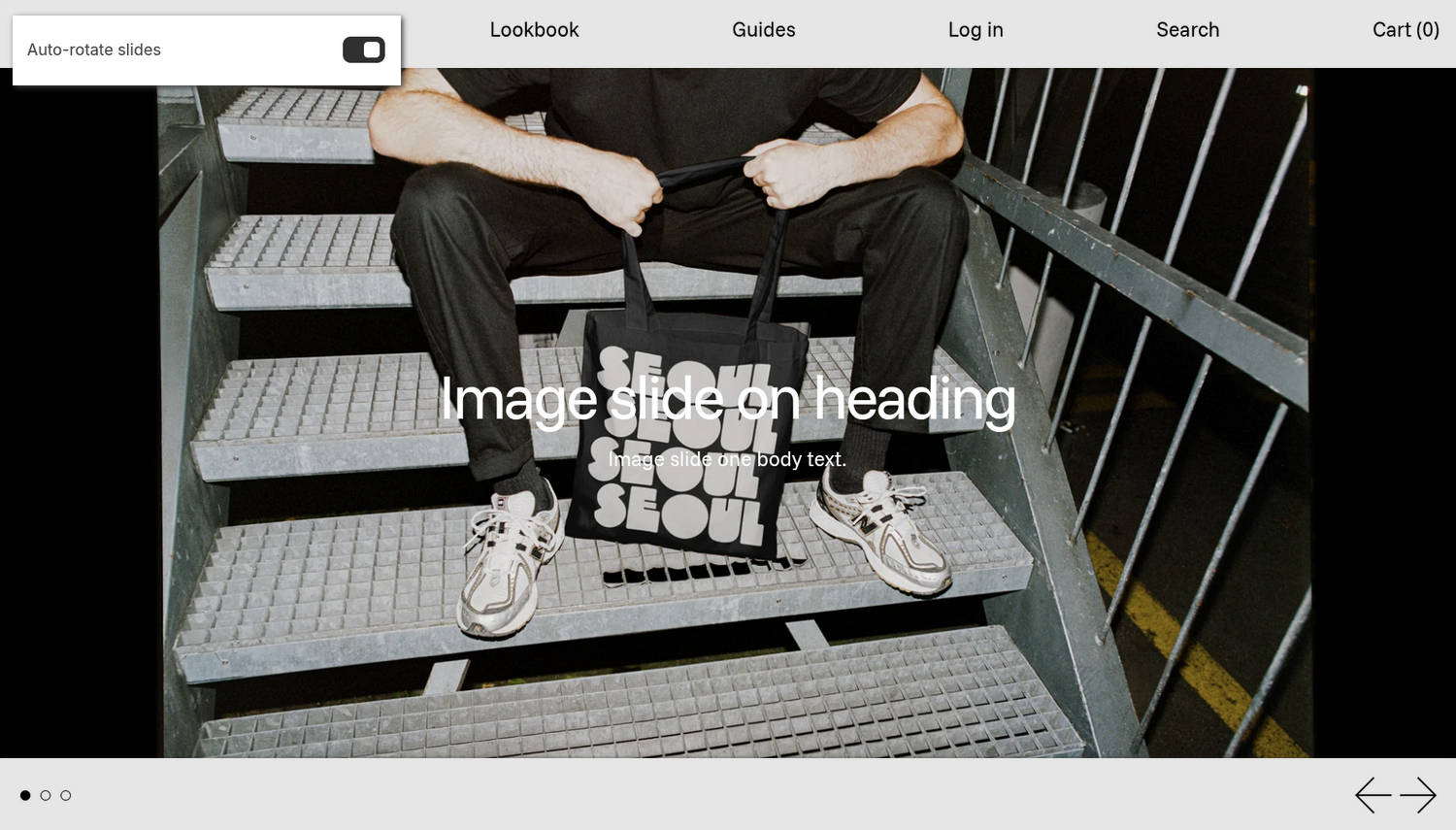
The previous image shows a Slideshow section on a store's home page. In the upper right, part of the Theme editor's section menu is displayed. The menu's Auto-rotate slides option is enabled. With this option enabled, the section automatically progresses to the next slide in the slideshow sequence. Note that enabling this option disables dragging between slides.
For general guidance with modifying sections, refer to Sections overview and Shopify help: Sections and blocks.
Set up a Slideshow section
To set up a Slideshow section:
In the Theme editor, at the top of the page, use the theme templates dropdown menu to select a page that contains a Slideshow section.
Note
The section can be added to any page except Checkout and Gift card pages. To add the section to the current page, select Add section > Slideshow. Refer to Shopify help: Add a section.
From the side menu, select Slideshow.
Select a setting described in the following table.
| Setting name | Description |
|---|---|
| Desktop height | Use the Desktop height options to select Adapt to first slide, Full screen, 3/4 screen, 2/3 screen, 1/2 screen, and more. This option specifies the height of the section's slideshow area on desktop display devices. Note that the Adapt to first slide option sets the height to match the height of the first slide. |
| Mobile height | Use the Mobile height options to select Adapt to first slide, Full screen, 3/4 screen, 2/3 screen, 1/2 screen, and more. This option specifies the height of the section's slideshow area on mobile display devices. Note that the Adapt to first slide option sets the height to match the height of the first slide. |
| Heading size | Use the Heading size options to apply the Standard, Feature, or Secondary heading size to the section's heading. Refer to Typography. |
| Auto-rotate slides | Use the Auto-rotate slides option to turn automatic playback on or off for the section's slideshow. Enabling this option disables dragging between slides. |
| Change slides every | Use the Change slides every options to specify the number of seconds to wait before showing the next slide. The options are 5, 6, 7, 8, 9, and 10 seconds. |
| Color > Color scheme | Use the Color scheme picker to select a color scheme for the section. Refer to Colors. |
| Theme settings | If available, select Theme settings to access additional settings for the section. Refer to Section theme settings menu. |
| Custom CSS | Select Custom CSS. In the CSS field, enter custom CSS styles to apply only to the current section. Refer to Shopify help: Add custom CSS. To apply custom styles to your entire online store, refer to Theme settings > Custom CSS. |
| Remove section | Select Remove section to delete the section from the current page. |
Note
To connect a metafield to a setting that supports metafields, select the Connect dynamic source icon displayed beside the setting in the Theme editor.
To learn how to connect a metafield to a supported setting, refer to Shopify help: Connecting metafields to your theme by using the Theme editor.
Configure a slide inside a Slideshow section
A default Slideshow section contains three slide blocks. To configure a block inside a Slideshow section:
In the Theme editor, at the top of the page, use the theme templates dropdown menu to select a page that contains a Slideshow section.
From the side menu, expand the Slideshow section menu.
To configure an existing block, select the block from the side menu.
To add a new block, select Add slide, then select the block you added.
Note
Inside the section, you can add, remove, show, hide, or move blocks. Refer to Configure blocks inside a section and Shopify help: Sections and blocks.
Apply the block settings described in the following table.
| Setting name | Description |
|---|---|
| Image | Use the Image picker to select an image to display inside the block on desktop display devices. Refer to Add, replace or remove an image or video inside a section or block. A landscape-oriented JPG image of at least 3,600 x 1,600 pixels is recommended. |
| Mobile image | Use the Mobile image picker to select an image to display inside the block on mobile display devices. Refer to Add, replace or remove an image or video inside a section or block. A portrait-oriented JPG image of at least 1,600 x 2,400 pixels is recommended. |
| Deep inset | Use the Deep inset option to show or hide a margin around the block's image. |
| Content > Subheading | In the Subheading field, enter text to display as a subheading for the block. Note that the Subheading field is hidden in the Theme editor when the Heading field is empty. |
| Content > Heading | In the Heading field, enter text to display as a heading for the block. |
| Content > Text | In the Text field, enter body text to display inside the block. Use the inline editor to format the text and add links, as needed. |
| Content > Position | Use the Position options to specify a position for text inside the block. The options are Top left, Top center, Top right, Left, and more. |
| Content > Width on desktop | Use the Width on desktop options to specify a width for the block's content area on desktop display devices. The options are One third, One half, Two thirds, and Full width. |
| Call to action > Link | In the Link field, enter an external URL or select a store page for the block's call to action link or button. |
| Call to action > Text | In the Text field, enter a single line of text to display as a label for the block's call to action link or button. |
| Call to action > Style | Use the Style option to select Link or Button. This setting lets you choose whether the call to action appears as a text link or a button. |
| Call to action > Button style | Use the Button style option to apply a Primary or Secondary button style to the block's call to action button. To use this option, set the Style option to Button. |
| Color > Color scheme | Use the Color scheme picker to select a color scheme for the block. Refer to Colors. |
| Color > Apply text color only | Set the Apply text color only option to on or off. When enabled, the chosen color scheme applies only to the block's text, keeping the rest of the block's colors unchanged. |
| Remove block | Select Remove block to delete the block from the current section. |